By Keith Brown
•
August 7, 2026
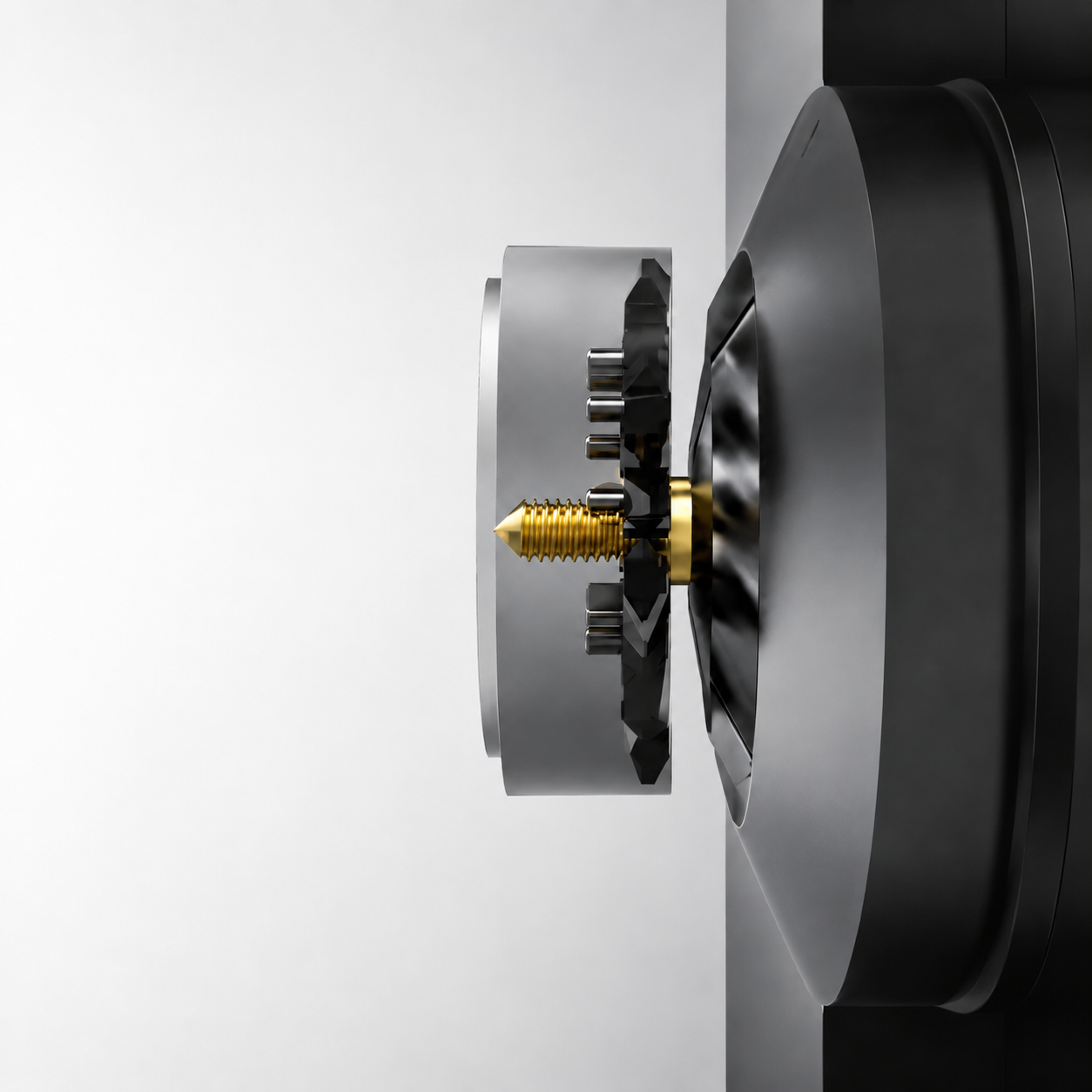
Ask anyone who runs bone screws, dental implants, or long aerospace fasteners on a Swiss machine what keeps them up at night, and thread quality on small-diameter parts is near the top of the list. The longer and thinner the part, the harder it fights back. THE PROBLEM Single-point threading works away from the part’s support. On a long length-to-diameter part — think a titanium bone screw many times longer than it is wide — the cutting force pushes against material that has room to flex. The bar deflects, and that deflection shows up as taper down the length, inconsistent thread form, and surface finish that breaks down toward the unsupported end. Because single-point threading builds the thread over multiple passes, every pass is another chance for variation to creep in, and every pass adds cycle time. In medical and aerospace work, where the thread form is often deep, increased-pitch, or multi-start, that’s not a cosmetic issue — it’s a scrap-rate issue. THE FIXES — WHAT YOU CAN TRY FIRST Before changing your whole approach, there’s real ground to gain by tightening up the process you already run. These fixes cost time and attention rather than capital: Workholding and support. Keep material support as close to the cut as possible — extended-nose guide bushings hold the bar within millimeters of the cutting point. Re-check and tighten rotary or sliding guide bushing clearance; loose clearance lets the bar push away under radial threading loads. And where the geometry allows, pre-turn the major diameter close to tolerance in a supported pass before the thread tool engages. Tooling. Move to sharp, polished, positive-geometry ground inserts rather than molded or dulled edges — a keener edge cuts cleaner and pushes less. Tough PVD-coated micro-grain carbide grades hold up to the low-to-medium surface speeds these materials demand without chipping. And an angled flank infeed, rather than a straight radial plunge, loads the cut primarily on one edge and reduces the side-pressure driving deflection. Programming. If your control supports it, apply spindle speed variation — modulating RPM by 10–20% during the cut breaks up the regenerative chatter frequency before it builds. Where the setup allows, a reverse pull-turning configuration converts radial push forces into axial tension, which stabilizes a small-diameter profile instead of bowing it. THE CEILING Here’s the honest part: these fixes help, but they manage the symptom rather than remove the cause. On a genuinely long, small-diameter threaded part, single-point threading is still working away from support and still building the form over multiple passes. There’s a point where you’ve dialed in everything you can and the process itself is the limit. THE FIX: GENSWISS® THREAD WHIRLING That’s where thread whirling changes the equation entirely. At FactoryLink Inc., we support thread whirling solutions from GenSwiss®. Instead of cutting away from support, a whirling system uses a rotating ring of inserts working right at the guide bushing — where the part is fully supported — and cuts the thread in a single pass from stock diameter. The deflection problem largely disappears because the cutting happens where the part is held, not out at the unsupported end. The advantages compound from there. Because whirling inserts get their side clearance from the tilt of the whirling spindle rather than from relieving material under the edge, they carry a stronger cutting edge and longer tool life than single-point tools. The single-pass approach eliminates the rough-and-finish insert matching that single-point threading requires, cutting setup and debugging time along with special support devices. And the finish itself is better: because the cutter enters and exits in a radial arc and contacts the part only at full tangency, whirling leaves a uniform surface — a real advantage on the 0° thread walls common on the trailing side of bone screws. GenSwiss builds this on a partnership with Utilis AG of Switzerland, putting more cutting teeth in the cut — up to twelve inserts, versus the three- and six-insert systems that came before — so a shop can run higher speeds and feeds while holding thread form. Their cutter rings, like the nine-pocket rings running double-lead custom-form inserts, are built around the exact demands of medical and aerospace threading. And where many whirling attachments run out of adjustment on multi-start threads, GenSwiss attachments adjust to ±25° of helix angle — enough range to handle the double- and triple-start threads that show up on modern implants and screws. THE PINNACLE: GENSWISS® TRUFORM® INSERTS If thread whirling is the fix, TruForm® is where it reaches its peak. GenSwiss® TruForm® triple-edge inserts are built for maximum precision in thread whirling — three cutting edges per insert, custom-ground to fit the most common three-sided whirling holders across whirling attachments and Swiss-CNC machines. Their sharper lead angles, matched to GenSwiss’s high-precision grind standards, produce burr-free threads, extended tool life, and a surface finish GenSwiss fairly calls jewelry-like. ThermoGuard and Aegis coatings keep the inserts running longer and support the high metal-removal rates that aggressive custom thread forms demand — the exact conditions found in bone screws, dental implants, worm gears, and semiconductor parts. For long, small-diameter threaded parts, that’s the full picture: cut at the guide bushing where the part is supported, put more teeth in the cut, match the helix to the thread, and finish it with an insert engineered for the peak of the process. That’s how a deflection fight becomes a repeatable, high-yield operation. Looking at a threaded part that won’t hold form on your Swiss machine? Reach out to FactoryLink Inc. to talk through whether GenSwiss® thread whirling with TruForm® inserts is the right fix for your application. For more information about how The Factory Link can improve your thread whirling workflow contact us!