
Holes That Won't Hold Size: Drilling, Reaming, and Where It Goes Wrong

The first part off the machine checks good. The pin gauge drops in with the right feel. By mid-shift, the same gauge is snug. By the end of the run, it won't go, or it falls through.
Nothing obvious changed. Same program, same tool, same material. That's what makes holes frustrating: the cause usually isn't the step where the size goes wrong. It's somewhere upstream: in the toolholder, in the drilled hole the reamer inherited, or in chips that never made it out.
Here's where we see hole size drift most often on the shop floors we walk, and how to decide what each hole actually needs.
Where Hole Size Goes Wrong
Runout. A drill or reamer that isn't running true cuts a hole larger than itself. A few tenths of runout at the holder can show up directly in the bore. Runout also changes as a holder wears, a collet loads up with debris, or a tool gets re-clamped after a change, which is why a hole can start good and drift.
The wrong amount of stock for the reamer. A reamer is a finishing tool, and it needs the right amount of material to cut. Too little, and it rubs instead of cutting: it glazes the wall, work-hardens some materials, and can close the hole up undersize. Too much, and it's doing a drill's job: it overloads, chatters, and can cut oversize. The reamer manufacturer's stock allowance chart for that size and material is the starting point.
A drilled hole the reamer can't fix. A reamer follows the hole it's given. If the drill wandered, the reamer follows it. Reaming improves size and finish; it doesn't correct position or straightness.
Chips that don't get out. In deeper holes and blind holes, packed chips get re-cut, scratch the wall, and push the tool off line. In small holes the margin for this is tiny, and a packed flute can break the tool.
Heat. Parts and tools grow when they're hot. A hole checked warm off the machine and checked again after it cools can read two different sizes. Consistent coolant delivery matters as much as coolant volume.
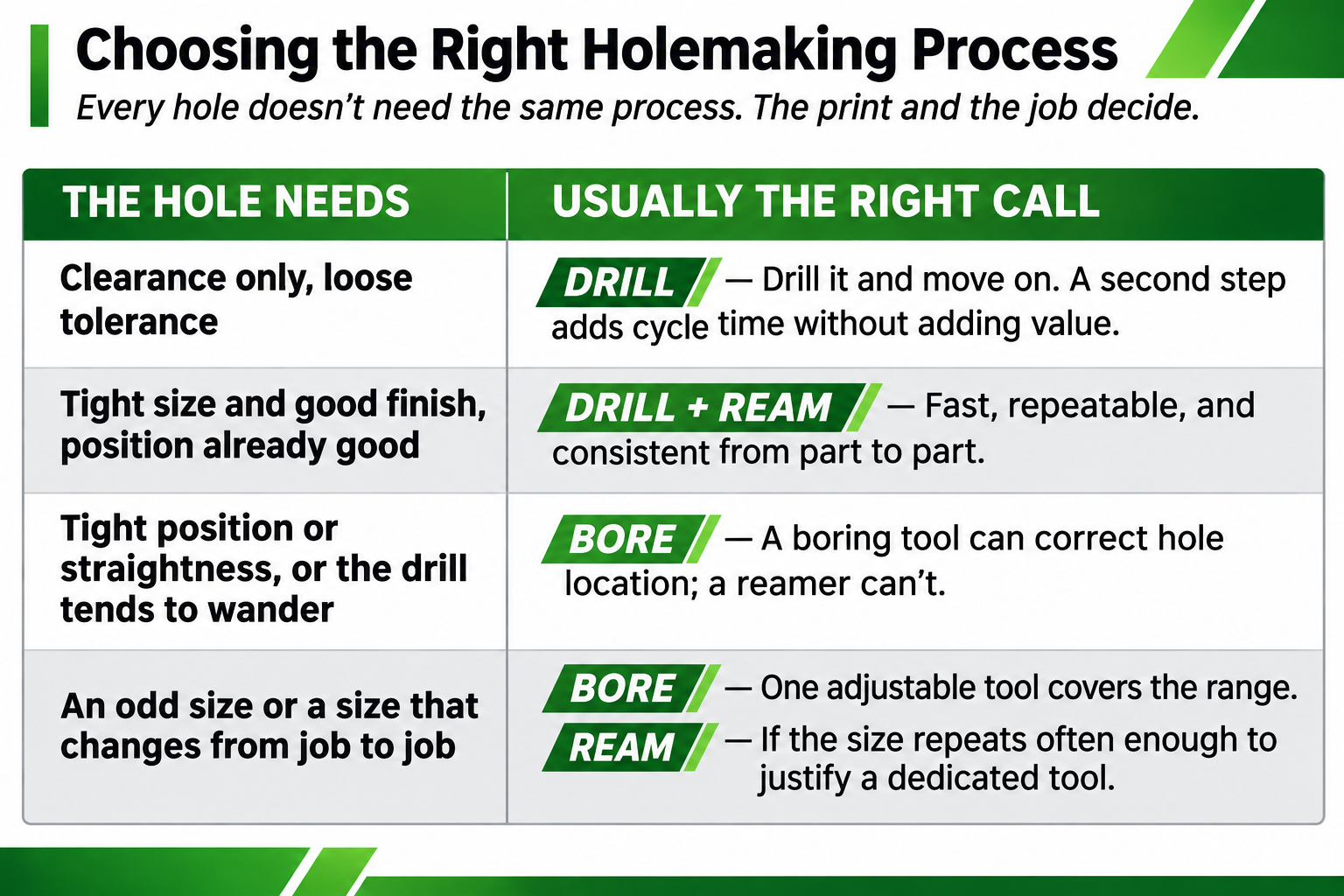
The answer can change with volume. On a long run of identical holes, a reamer's speed usually wins. On short runs of varying sizes, boring's flexibility often does.
Micro Holes: Medical and Dental
Everything above gets harder as the hole gets smaller. On a 0.5 mm drill, a runout figure that wouldn't matter on a 1/2" drill is a large share of the tool's diameter. It can mean an oversize hole or a broken drill.
What helps most in micro holes:
- Start the hole with a center or spot drill. A micro drill has almost no stiffness to resist walking on a curved or uneven surface.
- Hold runout as close to zero as the setup allows, and check it at the tool, not just the holder.
- Peck to clear chips in deeper holes, and match the peck depth to the drill's flute length and the material.
- Ream when the print calls for a true size. Small-diameter reamers come in fine increments, so a drilled micro hole can be finished to an exact size rather than to the nearest drill.
In medical and dental work, these holes often go into stainless, titanium and other tough materials, so tool material and geometry matter as much as setup.
One Hole, Three Stages: Pilot Precision
Pilot Precision's family of brands covers the life of a hole from start to finish, with each brand handling a different stage.
Making the small hole: GMauvaisUSA micro drills. Made in Annecy, France, with a history going back to the Swiss watch industry in 1928. Standard sizes run from 0.1 mm to 3 mm, in HSS-E 8% cobalt and micro-grain solid carbide, including center/pilot/spot drills for starting the hole straight.
Bringing it to size: Magafor carbide reamers. Solid carbide reamers from micro sizes up, offered in fine size increments, so a hole can be finished to the exact size on the print rather than the nearest standard.
Adding the feature after: duMONT by Pilot Precision. When a bore needs a keyway, duMONT Minute Man® keyway broaches cut it. The broach is guided by a bushing that sits in the bore, which is one more reason the bore has to be on size first.
Used together, they follow the hole the way the job does: start it straight, finish it to size, then add what the part needs.
The Bottom Line
When a hole won't hold size, the fix is rarely in the step where the problem shows up. Check the holder, the drilled hole, the stock left for the reamer, and the chips before you change the finishing tool.
If a hole is fighting you, call us. We'll figure it out.
/ Want this on your floor?
Let's run it on your toughest part.
Free, on-site demo across MI, OH, IN, KY, IL, PA, WV.