Spend Your Year-End Tooling Budget on Cost per Part, Not Price per Tool
Every November, the same question lands on a lot of shop floors: there's money left in the tooling budget, so what do we buy? The easy answer is to stretch it as far as it goes. Buy the cheapest tools, get the most of them, and call it a win.
That answer feels responsible. It's usually the expensive one. The price on a tool tells you what it costs to put in the crib. It doesn't tell you what it costs to make a part. That number, cost per part, is where year-end dollars actually pay off.
What Cost per Part Actually Measures
A commonly cited industry breakdown from Modern Machine Shop puts the cutting tool at only about 3% of a machined part's cost, with labor and machine time at roughly 30% each. The tool is the smallest piece of the bill, but it controls the biggest ones.
Cost per part pulls those pieces into one number:
- Tool cost per part: what you paid for the tool, divided by the parts it makes before it's done.
- Machine and labor cost per part: your shop rate multiplied by the cycle time.
- Changeover cost per part: the time spent swapping and touching off tools, spread across the parts each tool makes.
- Scrap and rework: every part a worn or inconsistent tool ruins.
A cheaper tool lowers only the first line. A better tool can lower all four.
The Math: A Hypothetical Comparison
Here's a simple example with made-up but realistic numbers. Two end mills run the same job on a machine billed at $100 per hour, with five minutes to change a tool.
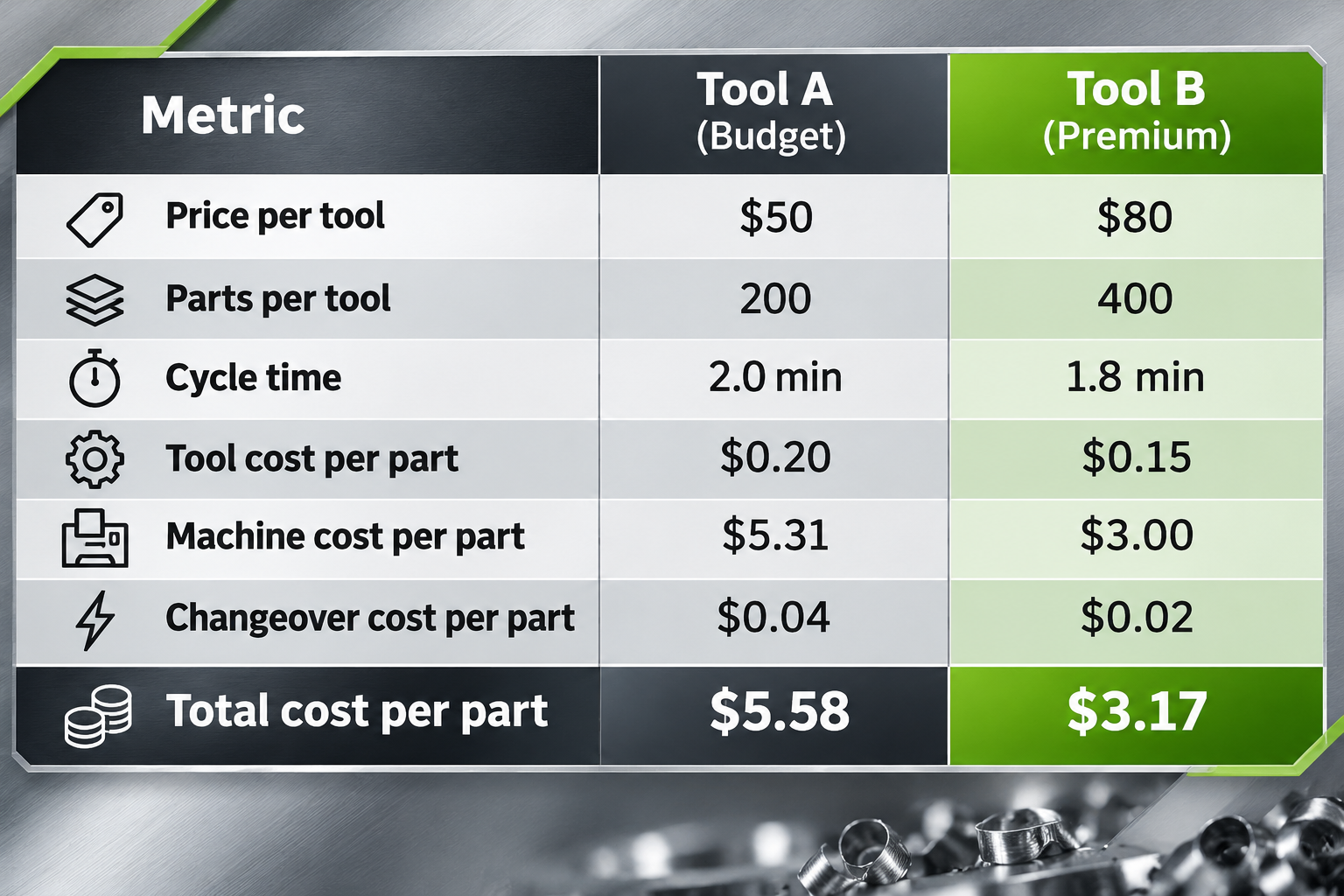
Tool B costs 50% more per tool and still saves about $0.40 on every part. Over a 10,000-part run, that's roughly $4,000 saved. The shop also buys 25 tools instead of 50, spends $1,500 on tooling instead of $2,000, and frees up about 33 hours of spindle time.
The cheaper tool looked like the budget-friendly choice. It ended up costing more in tooling and in time.
Where Year-End Dollars Move Cost per Part
Before the budget goes to whatever's cheapest, look at where the shop is losing time and parts:
- Longer tool life → fewer tools and fewer stops. A tool that lasts twice as long cuts both tool spend and changeover time per part.
- Higher speeds and feeds → shorter cycle times. Machine time is one of the largest costs on the part. Shaving seconds off every cycle adds up faster than any discount.
- Fewer changeovers → more spindle uptime. Every tool change is a few minutes the machine isn't making parts.
- Consistent performance → less scrap. A tool that wears predictably holds size longer and keeps bad parts from reaching inspection.
- The right tool for the bottleneck → the biggest payoff. Upgrading tooling on the job that ties up your busiest machine frees capacity where you need it most.
The Result
Spent on cost per part, a year-end tooling budget doesn't just restock the crib. It buys back machine time, cuts changeovers, and lowers the cost of every part the shop makes next year. The savings keep paying long after the budget resets.
Bottom Line
The cheapest tool and the cheapest part are rarely the same thing. Before you spend what's left this year, figure out which jobs cost you the most per part, then put the money there.
That's the same way FactoryLink approaches every problem. We start with the part print and the feature, the machine and what it can do, the material, your current parameters, and what success looks like: tool life, finish, cycle time, or tolerance. Sometimes the answer is a new tool from one of the brands we represent. Often it's tuning what you already run. Either way, the goal is a lower cost on every part, not a lower number on an invoice.
If you've got budget left and a job that's eating your margins, call us. We'll figure it out.
/ Want this on your floor?
Let's run it on your toughest part.
Free, on-site demo across MI, OH, IN, KY, IL, PA, WV.