The Machine Never Ran Itself: How American Machinists Built an Industry of Automation
Eight Decades of Partnership Between Skilled Workers and the Technology They Mastered
There's a story that gets told about automation — that it replaces workers. That every new machine is a step toward fewer people on the floor.
The actual history of American precision machining tells a different story entirely.
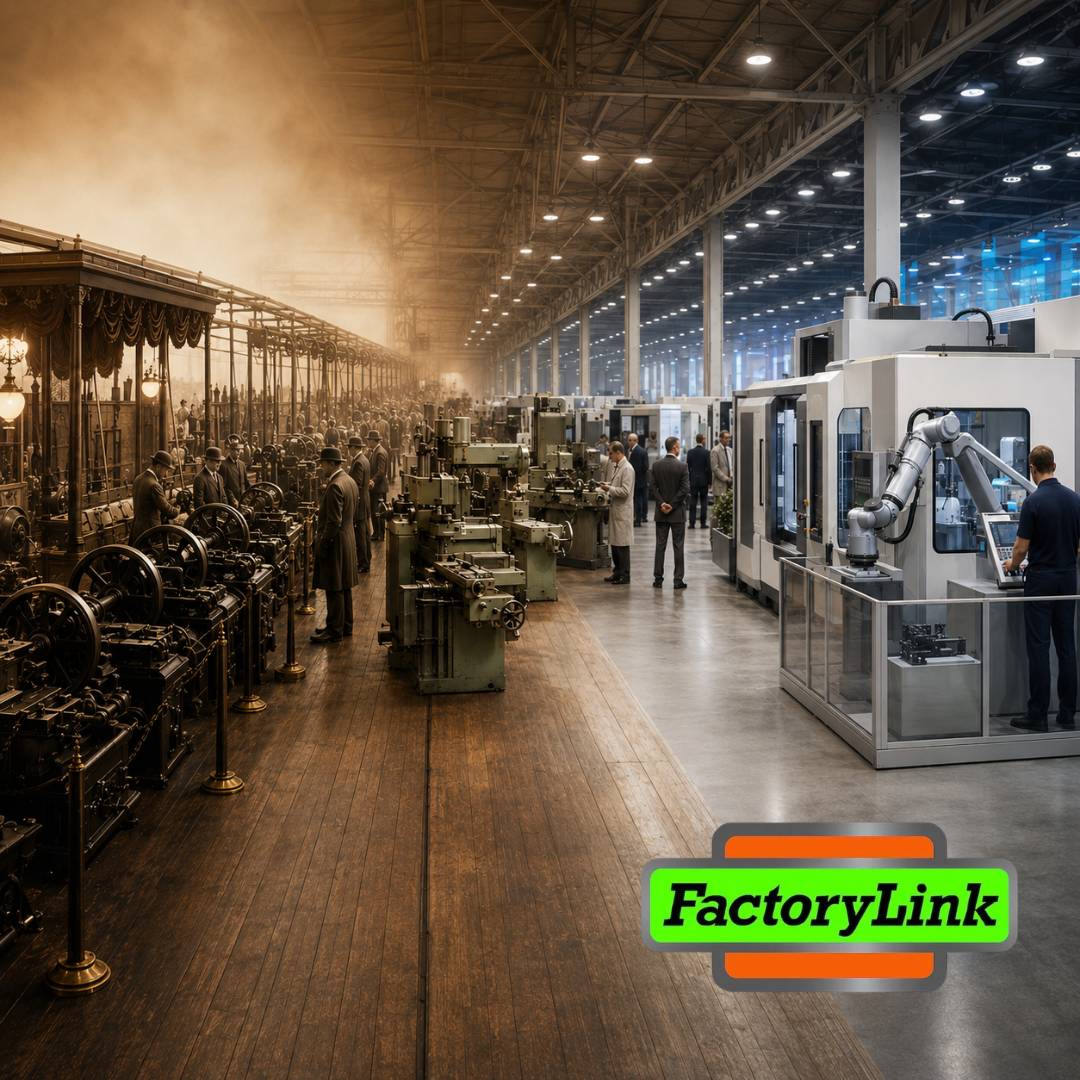
Over eight decades, from the post-war shop floors of the 1940s to the AI-driven machine centers running today, every technological leap in this industry created a new and more demanding conversation between the machine and the machinist. The tools got smarter. The people running them had to get smarter alongside them. Neither side of that partnership ever stopped being essential.
The 1940s–50s: The Foundation Was Always Human
The United States emerged from World War II having produced roughly 800,000 machine tools in support of the Allied effort. But a machine tool sitting still is just metal. What made those machines matter was the workforce behind them — and that workforce looked nothing like what the industry had before the war.
With men deployed overseas, women filled machine shops across the country in enormous numbers, trained in weeks or months rather than years. They ran the mills, operated the lathes, held the tolerances, and kept production moving at a pace and volume the war demanded. They proved something the industry would spend the next eight decades confirming: precision isn't only the product of time. It's the product of dedicated people.
That workforce won the war in the shops just as surely as soldiers won it in the field. And they deserve to be the first chapter of this story — because in every important way, they were.
As the Cold War began, the U.S. Air Force needed helicopter blades and jet aircraft components machined with a complexity that outpaced what even the best human operators could consistently deliver at scale. Michigan engineer John Parsons partnered with MIT to develop Numerical Control (NC) — using coded punch-card data to guide machine movements automatically. By 1952, the first NC milling machine ran publicly at MIT, reading from 7-track paper punch tape.
This was automation asking the machinist a new question. And the machinists who could answer it — who could translate their craft knowledge into the new language of coded instructions — became the most valuable people in American manufacturing. They were the artist-engineers who defined American Manufacturing.
The 1960s: A New Interface, Not a New Job
As mainframes shrank into minicomputers, NC became CNC — Computer Numerical Control. The machine now carried its own processing capability. Large automotive and aerospace companies began integrating CNC into their production lines, and a new figure emerged on the shop floor: the machinist who was also a programmer.
It was an expansion of skills. The operators making the transition still needed to understand what a good cut felt like, still needed to recognize when a tool was wearing, still needed to make decisions no program could anticipate. What changed was that they also needed to know how to communicate with a machine in its own language — and then watch it closely enough to know when it was getting the answer wrong.
The machine could execute. The machinist had to think.
The 1970s: Competition, Adaptation, and Who Survived
The microprocessor arrived and made CNC systems fully self-contained. No external mainframe required. The shop floor got smarter, faster, and more compact — and American manufacturers suddenly faced serious foreign competition. Japanese and German machine tool builders were exporting affordable, reliable CNC equipment that undercut domestic offerings in both price and performance.
The shops that survived this decade weren't necessarily the ones with the best machines. They were the ones with the best people — workers who could get more out of the equipment they had, who could learn new systems without losing their process instincts, who understood that technology was only as good as the hands guiding it. Those workers carried American manufacturing through one of the hardest competitive decades the industry ever faced with determination, skill, and pride.
The 1980s: When Software Changed the Conversation — Again
CAD/CAM platforms arrived and changed how parts were designed and programmed. Machinists no longer had to write G-code by hand line by line — they could build a part on screen and translate it directly to tool paths. Affordable CNC systems reached mid-sized and small job shops across the Midwest, making computer-controlled precision the baseline rather than a luxury.
But here's what the software couldn't do: it couldn't look at a tool path on a screen and know from experience that it was wrong. It couldn't sense that the feed rate was going to cause chatter on this particular material. It couldn't catch the error before it became a scrapped part.
The machinists who understood both the software and the metal became irreplaceable. Not because the technology needed them to fill a role — but because the technology genuinely couldn't do its job without them.
The 1990s: More Axes, Higher Stakes
4-axis and 5-axis machining brought cutting tools to virtually any angle on a workpiece, enabling geometries in a single setup that once required multiple operations and multiple skilled hands. High-Speed Machining — carbide tooling, synthetic coatings, spindle motors spinning at tens of thousands of RPMs — cut cycle times dramatically and pushed tolerances tighter than previous generations of machinists had ever worked to.
Every one of those advances raised the bar for the operator. Setting up a 5-axis job correctly requires a spatial and mechanical understanding that no software generates on its own. Running high-speed toolpaths on hardened material without destroying the tool — and the part — requires knowing what the machine is telling you at every stage of the cut. The sophistication of the machinery demanded equivalent sophistication from the people running it.
The 2000s–2010s: Lights Out — Thanks to Extraordinary Setup
Lights-out manufacturing sounds like the moment humans finally left the building. The reality is that these machines depended even more on skilled operators who understood the craft.
For a machine to run unattended overnight — with robotic arm loading, automatic pallet changes, and no operator on the floor — every single decision had to be made correctly before the last person walked out the door. Every offset. Every tool compensation. Every fixturing sequence. Every contingency. The discipline and expertise required to set up a lights-out job is extraordinary. The machine could run itself. The machinist had to make sure it was worthy of that trust.
Hybrid machine centers arrived in this era too — platforms that could 3D-print a rough metal form and then mill it to a finished specification without moving the part. A single skilled operator was now managing a process that once required teams across multiple departments. The consolidation of capability may have reduced the number of workers needed, but it made the human managing it more important, not less.
The 2020s: Smarter Machines, Still Guided by People
Today's machine shop is a networked system. IoT sensors feed real-time data to cloud dashboards. Artificial intelligence monitors tool wear, models vibration signatures, and predicts failures before they occur — swapping a cutting tool before it breaks rather than after.
And skilled machinists are still at the center of it. They're the ones who configure the monitoring systems, interpret what the data actually means for their specific process, and make the judgment calls that no algorithm is built to make. The AI is extraordinarily capable. But it’s not a replacement for the knowledge and experience of the machinist. Automation requires a skilled human to turn a piece of material into a functioning product. It requires the operator to understand its outputs, and to act on them with the kind of process knowledge that takes years to build.
The conversation between worker and machine has gotten more sophisticated than John Parsons could have imagined in 1949. The fundamental dynamic is exactly the same.
Eight Decades. One Partnership.
Automation didn't win. Workers didn't lose. What happened in American precision machining was something more interesting than either of those stories: a decades-long collaboration between human skill and mechanical capability, each pushing the other to develop further. This is something we have to remember going forward as AI becomes more capable. No matter how good it gets there will still be a need for hardworking machinists who elevate the process into an artform.
The machinists who built this industry — who learned punch tape and G-code and CAD/CAM and multi-axis programming and predictive AI tooling — deserve to be recognized for exactly what they are. Not workers who survived automation. Partners who evolved with the tools to make the industry better.
The machine has never run itself. It never will. And that's not a limitation. That's the point.
─────
Factory Link is proud to serve the Midwest shops and the people who run them — connecting precision manufacturing with the tooling systems that let skilled workers do their best work. Follow for more on the history, craft, and partnership behind American machining.