The Burr That Won't Budge: Why Conventional Tools Fail on Aggressive Deburring
You ran the program perfectly. The part came out on spec. And then you spotted it — a thick, ragged burr curling out of a cross-hole, sitting right at the edge of a fluid port, laughing at you from inside a groove your chamfer mill couldn't reach. You've been here before.
Aggressive burrs on complex geometry aren't just an inconvenience. They're a quality risk, a cycle time problem, and — depending on the application — a potential failure point. The shop's instinct is usually to reach for what's available: a die grinder, a chamfer cycle, maybe the tumbler. Here's the honest truth about how those play out.
In a Pinch: What Shops Usually Try
These alternatives can remove burrs. What they can't do is remove them reliably, consistently, and without risk to the part.
1. Solid Carbide Rotary Files & Die Grinders
A pneumatic die grinder with a carbide burr bit is the go-to improvised solution. It's fast, it's available, and it works — until operator fatigue sets in. Because the tool is completely rigid, steadiness is everything. A minor slip doesn't just scratch the surface; it gouges the part, blows tolerances, or rolls the edge in a way that can't be corrected downstream. On a high-value part, that's a scrap call.
2. Rigid CNC Chamfer Mills (Back Chamfering Tools)
Programming a chamfer cycle feels like the clean solution. The problem is that solid cutting bits cannot compensate for real-world dimensional variation in the parts they're cutting. A fraction of a millimeter off-spec means the rigid cutter over-deburrs one side and misses the burr entirely on the other. The result is inconsistent edge geometry across a production run — which is often worse than the original burr.
3. Heavy Vibratory Tumbling
Tumbling works across the entire surface of the part simultaneously, which is exactly the problem. To wear down a stubborn burr, the part has to run long enough that the tumbling media starts attacking threads, polished surfaces, and exterior dimensions alongside it. Internal cross-holes and hidden passages may not see the media at all. It's a blunt instrument in an application that demands precision.
The Fix: ESS Whisk™
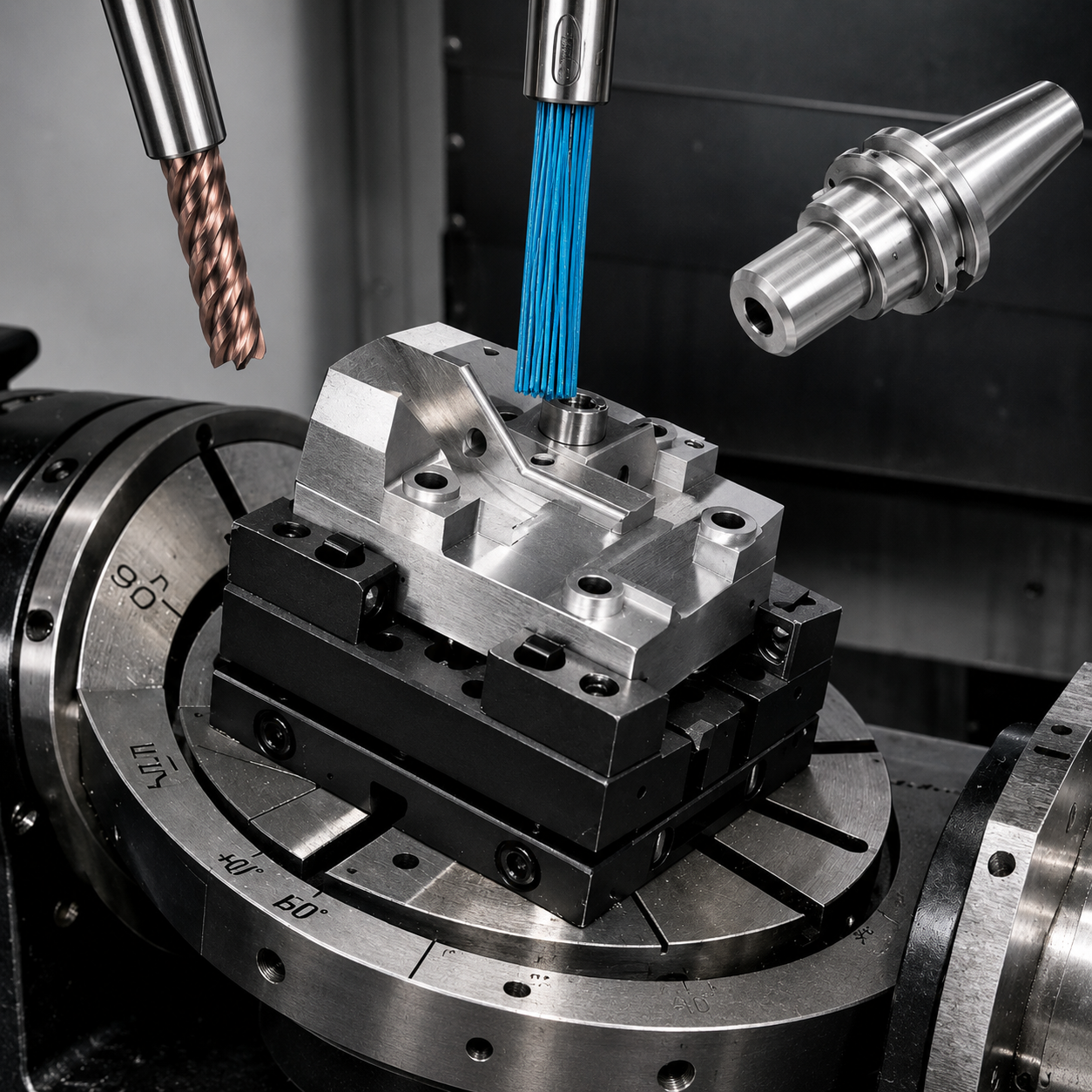
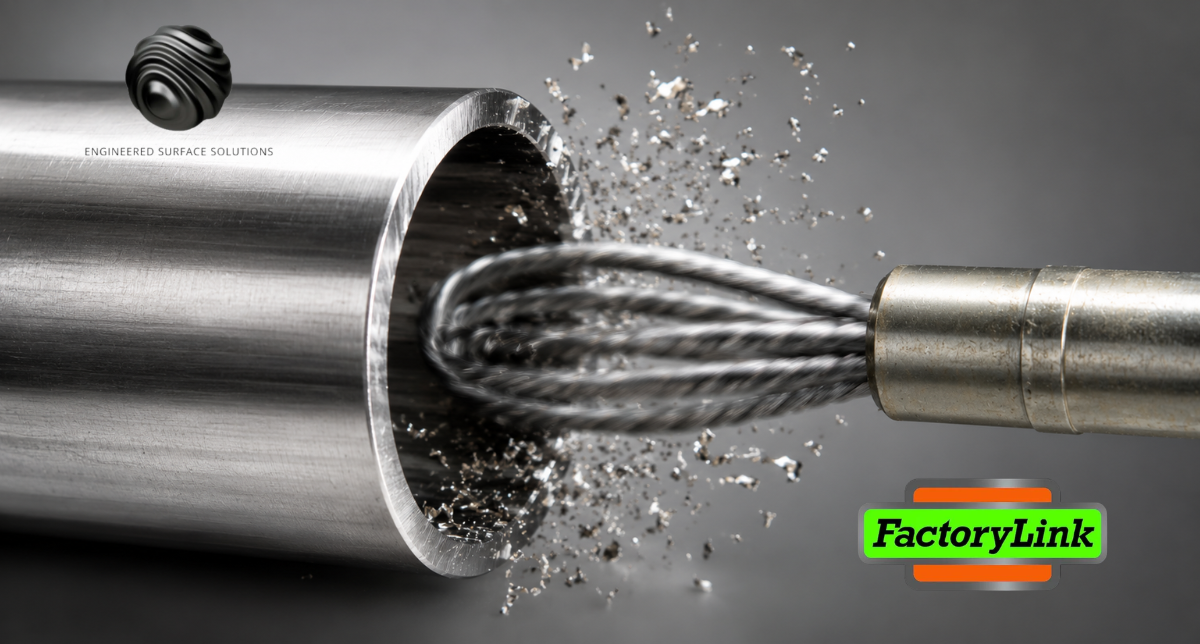
The ESS Whisk™ is a CNC lantern-style deburring tool built specifically for the situations listed above. Its flexible radial brush cluster doesn't just touch complex geometry — it conforms to it. Cross-holes, intersecting features, slots, grooves, and irregular edges are exactly where the Whisk outperforms rigid tooling.
What makes it viable for aggressive deburring is the filament design. The Whisk cuts harder and faster than traditional brushes, which means it handles thick burrs and heavy edge buildup without requiring the tool to press harder and risk damaging the part. Because it flexes to the geometry rather than forcing the geometry to the tool, it maintains edge integrity and part accuracy throughout the deburring cycle.
It's also designed for CNC integration and robotic cells — meaning it fits into an existing programmed cycle rather than pulling a machinist off the machine for manual cleanup.
Confirmed material compatibility:
• Hardened alloys
• Aluminum & stainless steel
• Titanium & nickel alloys
• Tool steels
Primary application targets:
• Cross-hole deburring
• Internal passages & fluid ports
• Precision edges on CNC-milled & turned parts
• Fine edge blending after reaming, drilling, or turning
• Medical, aerospace, and automotive valve/port edge applications
Why This Matters on the Shop Floor
The cost of a missed burr isn't just the part. It's the downstream inspection catch, the rework cycle, or worse — the field failure. Shops running precision components can't afford to treat deburring as an afterthought and expect to make it up with manual labor.
The ESS Whisk™ turns an inconsistent, operator-dependent cleanup step into a repeatable, programmable part of the machining cycle. That's not a small thing when your tolerances are tight and your volumes are real.
At Factory Link, we trust ESS Surface Solutions and their full line of precision deburring and surface finishing tools for machining shops. If you're running into stubborn burrs on complex geometry and want to see how the Whisk fits your operation, let's talk.