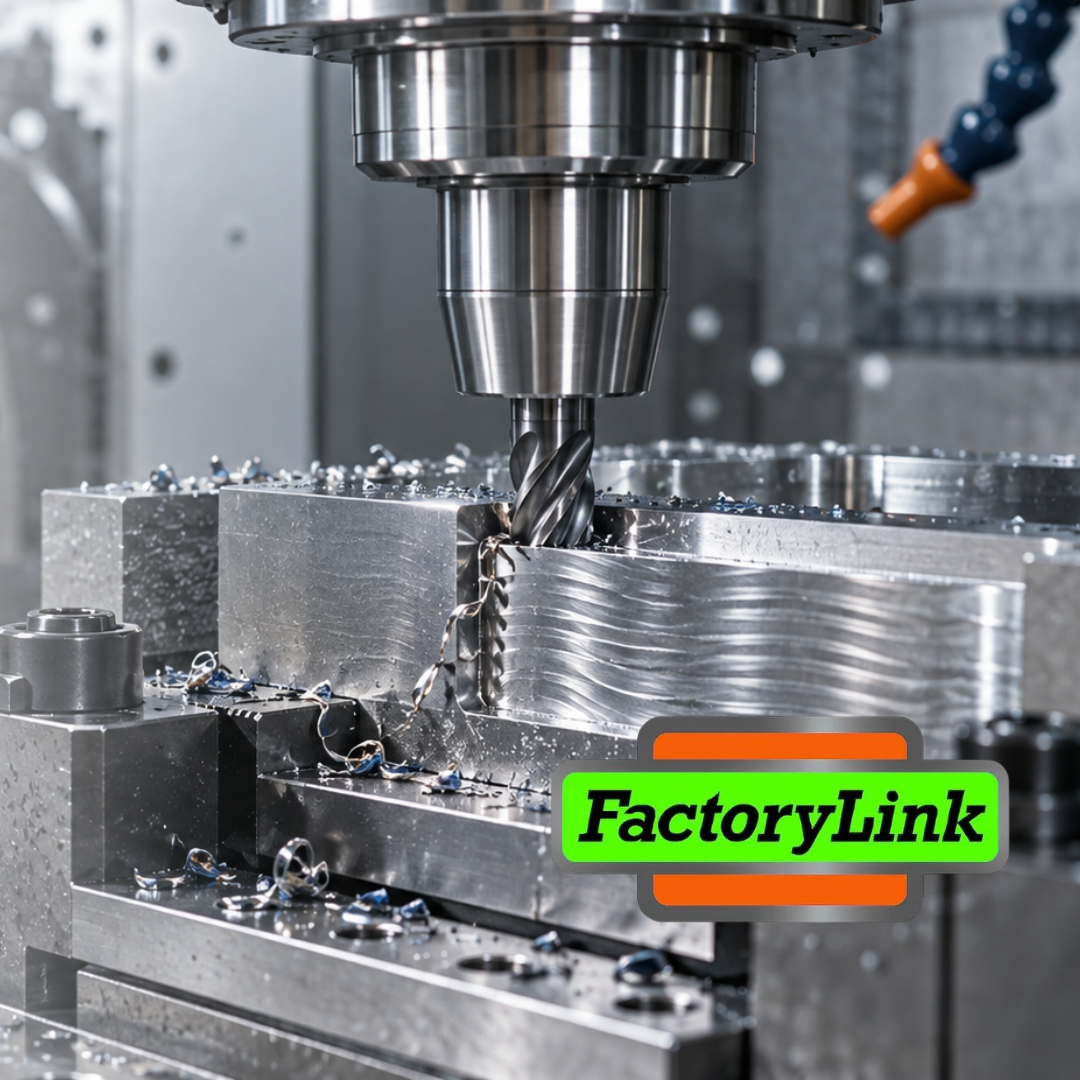
You've dropped the RPM. You've backed off the feed. The chatter is still there.
That doesn't mean anyone missed something. Speeds and feeds are the first lever most shops reach for because they're the fastest to change. But chatter is vibration, and vibration comes from the whole system: the machine, the workholding, the holder, the tool, and how the tool engages the material. When the parameters are already reasonable, the cause is usually somewhere else in that chain.
Here's where we look when the obvious fixes haven't worked.
Rigidity and Setup
Tool overhang. A tool sticking out of its holder behaves like a cantilevered beam. Deflection grows with the cube of stick-out length, so doubling the overhang means roughly eight times the deflection under the same load. Shortening the distance from holder face to cutting edge is one of the fastest stiffness gains available.
Workholding stability. If the vise, the fixture, or a thin-walled part flexes under cutting pressure, the tool is cutting a moving target. No parameter change fully makes up for a part that moves.
Machine condition. Worn linear guides or play in the spindle bearings reduce the stiffness and damping of the machine itself. That vibration shows up no matter what holder or tool is in the spindle.
Tooling and Cutting Dynamics
Runout. If the holder doesn't run true, one flute takes a heavier chip than the others. That uneven load creates a repeating impact every revolution, and that impact can drive vibration.
Flute geometry. Tools with evenly spaced flutes and a constant helix strike the material at a steady, predictable rhythm. If that rhythm lines up with a natural frequency of the setup, vibration builds. Variable helix or unequal flute spacing breaks up that rhythm.
Climb vs. conventional milling. Climb milling starts each chip thick and finishes it thin, so the edge enters the material cleanly instead of rubbing. On a rigid machine, that usually means a more stable cut. One caveat: on a machine with backlash in the axes, climb milling can pull the table into the cut. That's one more reason machine condition matters.
Engagement. Radial and axial depth of cut determine how many flutes are in the material at once and how the load changes as each one enters and exits. Changing the balance between step-over and step-down changes that load pattern and can move a cut from unstable to stable.
Where the Holder and Tool Make the Difference
Some of these causes are solved with setup changes or machine maintenance. Overhang and runout are solved at the holder and the tool. That's where GS Tooling by Sowa shrink fit holders and PFERD TOOLS solid carbide end mills fit.
GS Tooling by Sowa Shrink Fit Holders
Concentricity under 0.0001" (3 µm). The holder is heated to expand the bore, then cools to grip the tool 360° along the full length of the bore. Every flute takes an even chip load, which minimizes runout as a source of vibration.
Shorter projections. With no nut or set screw at the nose, shrink fit allows shorter tool projections. Less stick-out means more rigidity and less deflection.
Balanced to G2.5 at 30,000 RPM. Balancing doesn't change the holder's stiffness, but it minimizes the vibration an unbalanced holder adds at high spindle speeds.
Four nose coolant ports. Coolant reaches the cutting zone and clears chips before they get recut. Recut chips cause sudden load spikes that can start a tool bouncing.
PFERD TOOLS Solid Carbide End Mills
Built for the material. The Performance Stainless line (HC4M, HCD5M) and Performance Aluminum line (HC3N) are designed for those materials specifically, not as general-purpose tools.
Chip splitters. The HCD5M and UCD5 feature chip splitters that break chips into shorter segments. Smaller chips mean lower cutting forces, and lower forces mean less energy feeding vibration.
HA shanks for shrink fit. The HC4M and HC3N are available with smooth cylindrical HA (DIN 6535) shanks. For shrink fit, spec HA. A Weldon flat interrupts the 360° contact in the bore and costs grip and concentricity.
Paired together, Sowa holds the tool true and short. PFERD TOOLS puts the right geometry in the cut.
The Result
With overhang minimized, runout under 0.0001", and a tool built for the material, the holder and the tool are controlled as chatter sources. If vibration remains, it points clearly to the setup, the workholding, or the machine. Either way, you're diagnosing instead of guessing, and adjusting speeds and feeds becomes fine-tuning instead of a workaround.
The Bottom Line
Chatter is a system problem. Speeds and feeds are one part of that system, and often not the part causing it. If you've adjusted your parameters and the chatter hasn't moved, call us. We'll look at the whole setup with you and figure it out.
/ Want this on your floor?
Let's run it on your toughest part.
Free, on-site demo across MI, OH, IN, KY, IL, PA, WV.